The IAU has admitted 11 new Honorary Members, announced during the IAU Business Sessions, held virtually from 23 to 26 August 2021. This membership category, introduced at the XXX General Assembly, held in August 2018 in Vienna, gives official recognition to individuals who have significantly contributed to the progress of astronomical research and culture in their country, but who do not qualify as Individual Members.
Such individuals may be admitted by the IAU Executive Committee after a nomination by a National Member or the President of a Division. At the triennium Business Sessions held this month, the IAU was proud to admit the following 11 individuals as Honorary Members:
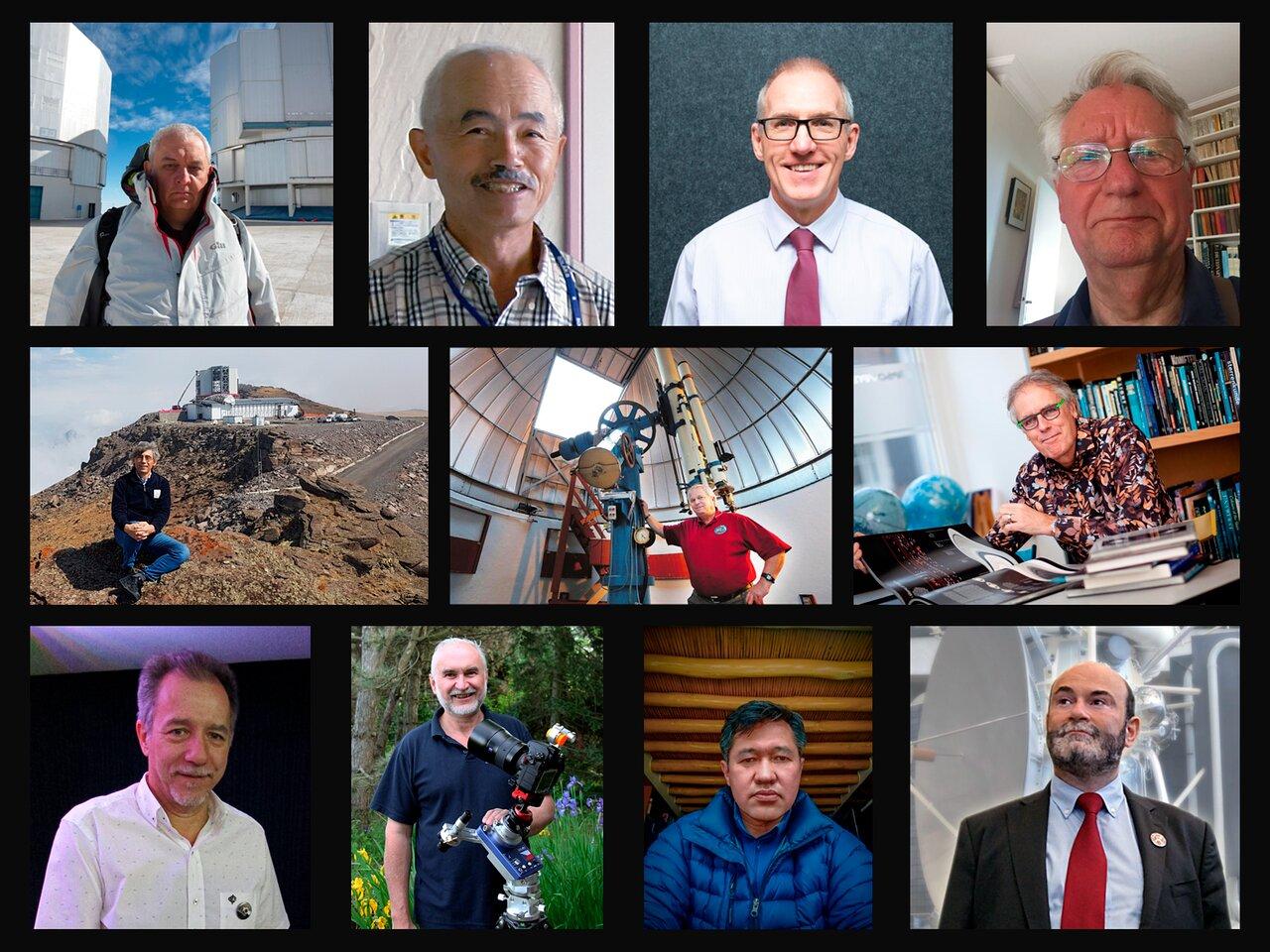
Credit: IAU | From Top Left to lower right: Vadym Zhukov, Masao Nakagiri, David Anthony Luchetti, Bernard Christophe, Erkan Şahmalı, Richard Huziak, Govert Schilling, Santiago Paolantonio, Zdenek Bardon, Dorje Angchuk, George A Danos.
Santiago Paolantonio
Nominated by: Asociación Argentina de Astronomía
Motivation: For his dedication to discovering the history of astronomy in Argentina, and his extensive contributions to the communication of astronomy through numerous books and articles, his blog “History of Astronomy” and his collaboration with the Córdoba Astronomical Observatory Museum.
Erkan Şahmalı
Nominated by: Turkish Astronomical Society
Motivation: For his architectural contributions to astronomy in Turkey, through his innovative design of the National Observatory of Turkey (TUG) and the Eastern Anatolia Observatory (currently under construction).
Dorje Angchuk
Nominated by: Indian National Committee
Motivation: For his passionate promotion of astronomy in the Ladakh region, through his excellent astrophotography, which has been published in The New Yorker Magazine and in the 2020 December issue of AAPPS journal.
Richard Huziak
Nominated by: Canadian Astronomical Society
Motivation: For his considerable contributions as an amateur astronomer to variable star astronomy, light pollution mitigation, and fireball and meteorite science, including being the second person to see, and thus confirm the existence of, Comet P/2001 Petriew.
Govert Schilling
Nominated by: Netherlands Astronomical Council
Motivation: For his extensive activities in the popularisation of astronomy, through his books (including children’s books), numerous magazine articles and contributions to Dutch TV and radio programmes.
Zdenek Bardon
Nominated by: Czech National Committee for Astronomy
Motivation: For his contributions to the development of astronomical infrastructure through leading the automation of many observatories across the world, and for his promotion of astrophotography and amateur astronomy.
Masao Nakagiri
Nominated by: Science Council of Japan
Motivation: For his dedication throughout his engineering career to the planning, building, operating and maintenance of several facilities in Japan, including the Tokyo Astronomical Observatory (TAO), the Okayama Astrophysical Observatory and the Subaru Telescope.
George A. Danos
Nominated by: Cyprus Space Exploration Organisation
Motivation: For his passionate promotion of astronomy, including leading campaigns that saw Cyprus join ESA, the IAU and COSPAR, as well as establishing the Cyprus Space Centre and helping Cyprus be selected as an International Astronomy Education Centre of the IAU OAE.
David Anthony Luchetti
Nominated by: Australian Academy of Science
Motivation: For his advocacy for astronomy in the Australian Department of Industry, Science, Energy and Resources, through supporting and managing investments in optical astronomy, and driving the progress of the SKA, as its Project Director.
Bernard Christophe
Nominated by: Société Française d’Astronomie et d’Astrophysique
Motivation: For his exceptional contributions as an amateur astronomer, including building his own 600-mm telescope with which he discovered 250 asteroids, and refurbishing an instrument called Miosotys, which allows detection of the passage of a trans-Neptunian object in front of a star.
Vadym Zhukov
Nominated by: National Academy of Science of Ukraine
Motivation: For his strong technical and financial support for astronomical projects, including the development, restoration and improvement of astronomical instruments and observatories, and the provision of research grants for astronomy students.