APRIM2026: ASIA-PACIFIC REGIONAL IAU MEETING
4 - 8 May 2026, Hong Kong
The Asia Pacific Regional International Astronomical Union (IAU) Meeting is a highly anticipated gathering that convenes astronomers, researchers, and enthusiasts from countries across the Asia Pacific region. This prestigious event provides a platform for the exchange of cutting-edge research, innovative ideas, and collaborative efforts in the field of astronomy, astrophysics, Space Science and Space Sustainability. Through a series of keynote presentations, panel discussions, workshops, and poster sessions, participants delve into a diverse array of topics encompassing planetary science, stellar evolution, galactic dynamics, cosmology, and observational astronomy. The Asia Pacific Regional IAU Meeting serves as a catalyst for fostering interdisciplinary collaborations, nurturing emerging talents, and advancing scientific knowledge in the dynamic and ever-evolving realm of astronomy. By facilitating networking opportunities and knowledge sharing among experts and enthusiasts, this meeting plays a pivotal role in shaping the future of astronomical research and exploration in the Asia Pacific region and beyond.
The Asia Pacific Regional International Astronomical Union (IAU) Meeting in 2026 (APRIM2026) will be hosted at Hong Kong University, offering a unique opportunity for space and astrophysics enthusiasts to showcase their research and contribute to the vibrant exchange of ideas in the field. Researchers, scientists, and academics are invited to submit abstracts and papers on a wide range of topics within space and astrophysics, including but not limited to planetary science, stellar evolution, galactic dynamics, cosmology, and observational astronomy. This prestigious event will provide a platform for participants to present their work, engage in discussions with peers, and establish valuable connections within the Asia Pacific astronomy community. The Asia Pacific IAU 2026 Meeting promises to be a stimulating and enriching experience for all those passionate about exploring the mysteries of the universe.
Contact
Quentin Parker
Meeting Circulars
Final Circular (April 2026)
Fourth Circular (March 2026)
Third Circular (January 2026)
Second Circular (October 2025)
First Circular (August 2025)
APRIM2026 Insights
Volunteer Reflections
|

|
“The most valuable part of the conference was engaging with the global astronomical community and discussing the integration of machine learning with planetary science.”
Aruna Devi, India
|
|
| Aruna uses Artificial Intelligence and Deep Learning to detect biosignatures in extreme environments, such as Mars and Enceladus. At APRIM, Aruna presented "MissionMaker," a simulation platform designed to democratize mission architecture for learners. |
|
|

|
“APRIM 2026 was more than a scientific meeting; it was a meaningful journey. I felt welcomed and inspired by researchers and students from many countries. I was especially grateful for friendships with fellow women students, including Hsiang-Yu Chen from Taiwan and Sumi Bhattacharjee from India, whose warmth made me feel part of a larger astronomy family. The outreach sessions reminded me that astronomy can bring hope and curiosity to communities with limited access. I sincerely thank the IAU for this precious opportunity and support.”
Muthia Dewi, Indonesia
|
|
| Muthia Dewi, Institut Teknologi Bandung (ITB), Indonesia, presented the poster, “The ω¹ Sco Star: Spectral Variation Analysis of a β Cephei-Type Pulsator.” Under Dr. Aprilia’s supervision, this research explored the possible link between pulsation and emission phenomena in the variable star ω¹ Sco through period analysis. Using the Lomb-Scargle Periodogram, the photometric data yielded a variability period of 9.114 days. This period was compared with spectroscopic data from Bosscha Observatory (2019–2020). Among six spectra, only one showed emission lines—Ce II and Ca I—whose timing was consistent with the derived period, although the limited dataset may affect the confidence of this result. |
|
|
|
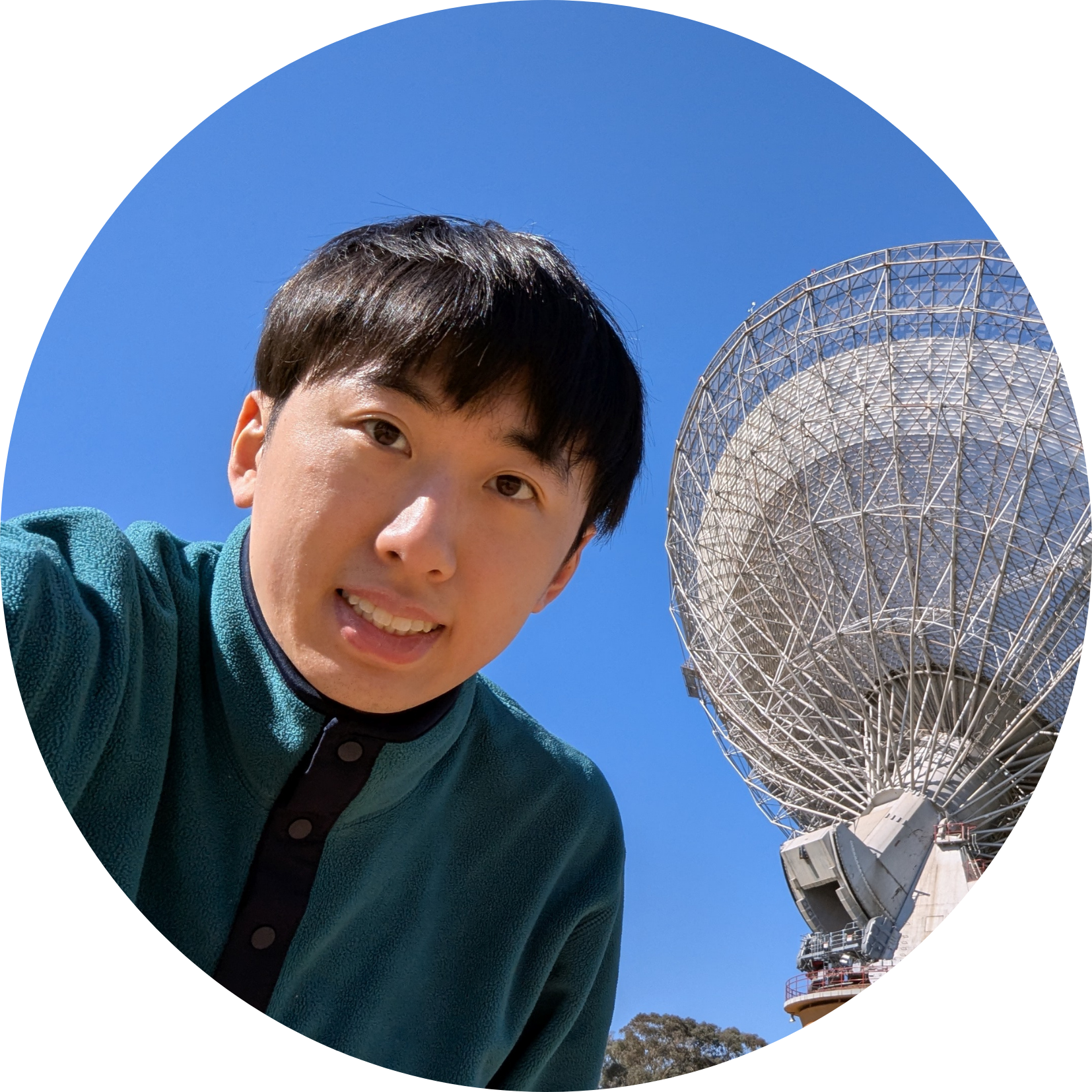
Simon, a final-year PhD student in Australia, researches fast radio transients, particularly fast radio bursts (FRBs) and pulsar giant pulses, using observations from radio telescopes including MeerKAT, FAST, and BURSTT. His work explores the origins of these energetic transient signals, their connection to neutron stars and globular clusters, and their applications in astrophysics and cosmology. In particular, he has studied giant pulses from the millisecond pulsar PSR J1823−3021A with MeerKAT and conducted searches for FRBs from globular clusters in nearby galaxies using FAST. He also works on signal-processing techniques and transient-search pipelines for radio astronomy data.
Simon Ho, Australia/Hong Kong
|
|
|

|
“Participating in APRIM 2026 was a highly enriching experience. I especially valued the opportunity to learn about recent developments across different fields, interact with experts and young researchers, and discuss ideas that may lead to future collaborations.”
Harshita LAWANIA, India
|
|
| Harshita’s research focuses on shock wave propagation in rotating self-gravitating ideal gas in the influence of magnetic field. In this work, similarity solutions for a self-gravitating perfect gas with variable density under the influence of a magnetic field were obtained using the Lie group theoretic method. A one-parameter infinitesimal transformation group was introduced to derive infinitesimal generators and corresponding similarity transformations. The governing partial differential equations were transformed to ordinary differential equations for power-law and exponential-law shock paths, and numerical solutions were computed using Mathematica. This study explores the influence of important physical parameters such as shock Cowling number, gravitation and rotation parameters, adiabatic index, and ambient density variation index on shock wave propagation. These results are relevant to several astrophysical processes, including galactic winds, supernova explosions, accretion disks, and solar wind interactions near Earth’s magnetosphere. |
|
|

|
“What made APRIM special for me wasn't just the science (which was great), but the way the parallel sessions threw me into conversations I'd never have had at a traditional single-topic meeting. The outreach side especially caught me off guard - in the best way. I came away with fresh ideas for visualising complex work, met wonderful people doing creative outreach, and felt genuinely re-energised about how we connect our science with the world outside.”
Monserrat Martínez-Marín, Chile
|
|
| Monserrat, currently a postdoc at MINGAL at the University of Concepción, has conducted research across galaxy evolution - from phylogenetic studies of the Coma cluster and field galaxies, to teaching machines to classify galaxy morphology, to chasing massive quiescent galaxies and AGN at high redshift. At APRIM, he shared his latest project called "Mapping Galaxy Evolution with Unsupervised Phylogenetics, where we basically let galaxies tell us their own evolutionary stories using a phylogenetic tree built from the latent space of their spectra”. |
|
|

|
Antonia Rahayu Rosaria Wibowo, researcher at the National Research and Innovation Agency, Indonesia studies the relationships between astronomical facilities and Indigenous communities. At APRIM 2026, Antonia presented a benchmarking study on how astrotourism can have twofold benefits: achieving space sustainability and preserving Indigenous astronomical knowledge. The study presents three recommendations for Indonesia to develop a sustainable astrotourism program that can benefit Indigenous communities whose land is used to develop the observatory.
Antonia Rahayu Rosaria Wibowo, Indonesia
|
|