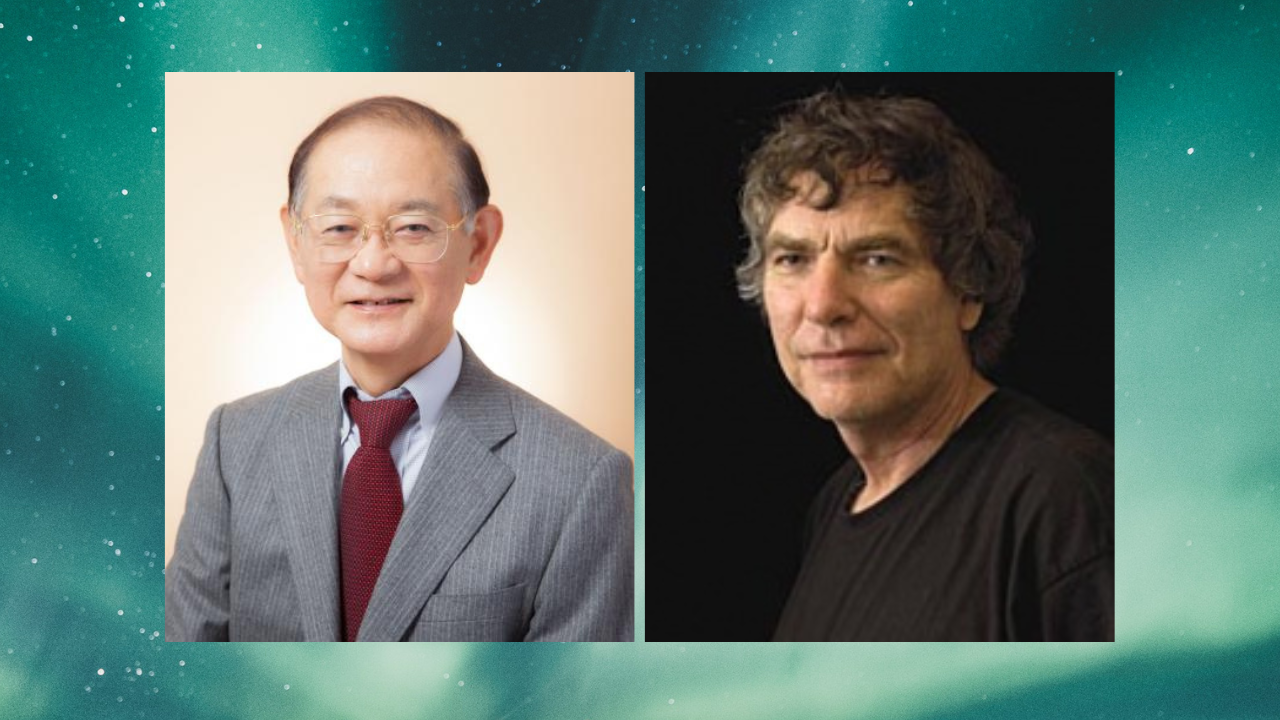
2026 Shaw Prize in Astronomy Laureates from left to right:
Ken'ichi Nomoto, and Stanford Woosley
The Shaw Prize in Astronomy 2026 is awarded in equal shares to Ken’ichi Nomoto (Emeritus Professor and Visiting Senior Scientist of the Kavli Institute for the Physics and Mathematics of the Universe, University of Tokyo, Japan) and Stanford Woosley (Professor of Astronomy and Astrophysics, University of California, Santa Cruz, USA) for their studies of stellar explosions and the origin of the elements.
A supernova is a powerful explosion of a star, radiating in days about as much energy as the Sun emits in its 10 billion-year lifetime, giving birth to the most exotic states of matter known — neutron stars and black holes. The brightness characteristics of supernovae can serve as standard candles, allowing us to measure the expansion of the universe. Supernovae drive the dynamics of the interstellar gas from which stars are born, produce interstellar dust, generate galactic cosmic rays, and forge many of the chemical elements in the periodic table, including those that form our planet and our bodies.
Ken’ichi Nomoto and Stanford Woosley (and their collaborators) have played a central role in advancing our understanding of the end stages of stellar evolution, the observational signatures and diverse origins of supernovae and other stellar explosions, and their production of new chemical elements. Their models — in particular of light curves (luminosity and spectra versus time) and nucleosynthesis (formation of new elements) — have guided increasingly sophisticated and extensive observational studies and anchored the interpretation of these programmes. Their work has been almost entirely independent and often complementary.
Nomoto and Woosley produced the standard models for thermonuclear supernovae caused by accretion of matter onto a white dwarf from a companion star. Their careful studies of the propagation of nuclear burning through the star combined with detailed nuclear reaction networks allowed predictions of the production of chemical elements from the explosion. They used these predictions to carry out the first comprehensive galactic chemical evolution calculations, which are widely used to understand the origin of the chemical elements through the record of the chemical composition of stars and to identify the earliest generations of stars.
The Shaw Prize recognises Nomoto's and Woosley's fundamental contributions to our understanding of the diversity and the key observational signatures of these spectacular explosions, and the origin of the chemical elements found in today’s universe.
About the Laureates
Ken’ichi Nomoto was born in 1946 in Tokyo, Japan and is currently at the University of Tokyo, where he is both an Emeritus Professor and also Visiting Senior Scientist of the Kavli Institute for the Physics and Mathematics of the Universe. He received his Bachelor’s degree and the PhD from the University of Tokyo in 1969 and 1974, respectively. Following postdoctoral fellowships at the Japan Society for the Promotion of Science, he was appointed Assistant Professor at Ibaraki University, Japan (1976–1981). Afterwards, he returned to the University of Tokyo, where he served successively as Assistant Professor (1982–1985), Associate Professor (1985–1993), Professor (1993–2010) and Emeritus Professor (2010–). He served as Principal Investigator (2007–2017) and Project Professor (2008–2017) at the Kavli Institute for the Physics and Mathematics of the Universe, before becoming a Visiting Senior Scientist in 2017.
Stanford Woosley was born in 1944 in the USA and is currently Professor of Astronomy and Astrophysics, University of California, Santa Cruz, USA. He received his Bachelor’s degree and the PhD from Rice University, USA in 1966 and 1971, respectively. He was a Research Associate of Space, Physics and Astronomy at Rice University (1971–1973) and a Research Fellow in Physics at Kellogg Radiation Laboratory (1973–1975), California Institute of Technology, USA. He then joined the University of California, Santa Cruz, where he served successively as Assistant Professor (1975–1978), Associate Professor (1978–1983), and Professor of Astronomy (1983–). He is a member of the US National Academy of Sciences and the American Academy of Arts and Sciences.
About The Shaw Prize
The Shaw Prize consists of four annual prizes — Astronomy, Life Science and Medicine, and Mathematical Sciences, awarded since 2004, together with the newly introduced Computer Science Prize, to be awarded from 2027. Each bearing a monetary award of US$1.2 million. This will be the twenty-third year that the Prize has been awarded and the date of presentation ceremony will be announced in due course.